Saturday, July 15, 2017

Aeneas and the Women (Reflections Continued)

Johann Heinrich Tischbein
It's humorous to me that Aeneas, that heroic fighter and ultimate founder of Rome itself, is left seemingly quaking in fear of Queen Dido.  The excerpt below is one particularly illustrative example.

The pious prince was seiz'd with sudden fear; Mute was his tongue, and upright stood his hair. Revolving in his mind the stern command, He longs to fly, and loathes the charming land. What should he say? or how should he begin? What course, alas! remains to steer between Th' offended lover and the pow'rful queen? This way and that he turns his anxious mind, And all expedients tries, and none can find. Fix'd on the deed, but doubtful of the means, After long thought, to this advice he leans: Three chiefs he calls, commands them to repair The fleet, and ship their men with silent care; Some plausible pretense he bids them find, To color what in secret he design'd. Himself, meantime, the softest hours would choose, Before the love-sick lady heard the news; And move her tender mind, by slow degrees, To suffer what the sov'reign pow'r decrees: Jove will inspire him, when, and what to say. They hear with pleasure, and with haste obey. But soon the queen perceives the thin disguise: (What arts can blind a jealous woman's eyes!)

Virgil. The Aeneid English (Kindle Locations 1477-1487). Kindle Edition. 

     As William Congreve's poem "The Mourning Bride" describes the woman scorned, "heaven has no rage like love to hatred turned/Nor hell a fury like a woman scorned."  Even this heroic warrior is deeply troubled at the prospect of Queen Dido's anger unleashed upon him.  So much troubled, in fact, that he makes haste to quietly escape to sea.  I love the image of this...but it is no wonder that a man would want to avoid the woman's anger.


A woman moved is like a fountain troubled, Muddy, ill-seeming, thick, bereft of beauty; And while it is so, none so dry or thirsty Will deign to sip or touch one drop of it. Thy husband is thy lord, thy life, thy keeper, Thy head, thy sovereign; one that cares for thee, And for thy maintenance commits his body To painful labour both by sea and land, To watch the night in storms, the day in cold, Whilst thou liest warm at home, secure and safe; And craves no other tribute at thy hands But love, fair looks and true obedience; Too little payment for so great a debt. Such duty as the subject owes the prince Even such a woman oweth to her husband; And when she is froward, peevish, sullen, sour, And not obedient to his honest will, What is she but a foul contending rebel And graceless traitor to her loving lord?

Shakespeare, William. The Complete Works of Shakespeare (Kindle Locations 30349-30365). Latus ePublishing. Kindle Edition. 

Thoughts on Virgil's Aeneid

     Back at Eisenhower High School, studying Roman and Greek mythology under our teacher, simple Tom Kuykendall back then, represents some of my fondest academic memories.  Returning to Virgil's Aeneid, I am particularly struck but the powerful imagery and evocative language.  Here's one particular excerpt that caught my attention.  Interestingly enough, the translation quoted below uses the word "fame," whereas Robert Fitzgerald's translation uses the word "Rumor."  Odd that such different words would be synonymous in this context.


Fame, the great ill, from small beginnings grows: Swift from the first; and ev'ry moment brings New vigor to her flights, new pinions to her wings. Soon grows the pigmy to gigantic size; Her feet on earth, her forehead in the skies. Inrag'd against the gods, revengeful Earth Produc'd her last of the Titanian birth. Swift is her walk, more swift her winged haste: A monstrous phantom, horrible and vast. As many plumes as raise her lofty flight, So many piercing eyes inlarge her sight; Millions of opening mouths to Fame belong, And ev'ry mouth is furnish'd with a tongue, And round with list'ning ears the flying plague is hung. She fills the peaceful universe with cries; No slumbers ever close her wakeful eyes; By day, from lofty tow'rs her head she shews, And spreads thro' trembling crowds disastrous news; With court informers haunts, and royal spies; Things done relates, not done she feigns, and mingles truth with lies.

Virgil. The Aeneid English (Kindle Locations 1413-1421). Kindle Edition. 

     I love this description of rumor (or fame), as it so eloquently conveys the dark and pervasive nature of gossip.  (It's slightly reminiscent to me of the description of sin found in James 1:15.)  The honorable man, the hero abides by the middle of the way or via media.  

Art History Lecture Reflections (and Trip Thoughts)

     
"Sunflowers" by Vincent van Gogh
One particularly exciting dimension about my upcoming study abroad program (through Marylhurst University) in London and Rome is the riches of art we will have an opportunity to visit.  What a wonderful privilege and blessing!


     This really came home for me at last week's art lecture at MU.  The talk began with a discussion of the architecture of Rome.  As one of our professors, Dr. Roland, recounted of the Roman architecture and art descriptions of Dr. Jeffrey Blanchard on her Blog: A Passionate Geography: Romancing King Arthur's Roman War, "Rome, he explained, is a city of stratification and juxtaposition–a city where the architecture from one era is layered upon another, where marble columns are recycled into new uses, where buildings are joined together in surprising junctures."  I am going to have to pinch myself now.

     A personal concern is how am I possibly going to be able mentally record or capture the essence of Rome in only two weeks, or so?  I suppose the takeaway is that I probably cannot hope to do so--but that doesn't mean I won't try!  Our itinerary will likely have us visiting Museo Nazionale (National Roman Museum), Capitoline Museum, Galleria Nazionale d'Arte Antica, Borghese Gallery, and, of course, the Vatican.  (I plan to attend Holy Mass at Saint Peter's on either September 10th or/and 17th.) 


Bathers (Les Grandes Baigneuses) by Paul Cézanne


     In London, we will be visiting both the British Museum and the National Gallery.  At the National Gallery, I will be offering a few words on "Bathers," pictured above.  (Each student is researching and offering a short presentation on a particular piece of art that we will be seeing in-person.)  Coming face-to-face with great art is something much more profound than seeing a photograph or reproduction of the same work elsewhere.  As I have written in the past, great art and architecture (especially sacred space) takes us outside of our own timeline for a moment and connects us with those in the past, present, and future who have (or will) gazed upon a wondrous masterpiece of art.  


Bathers at Asnières by Georges Seurat.


Tuesday, July 4, 2017

Thoughts on Geoffrey of Monmouth's "The Kings of Britain"

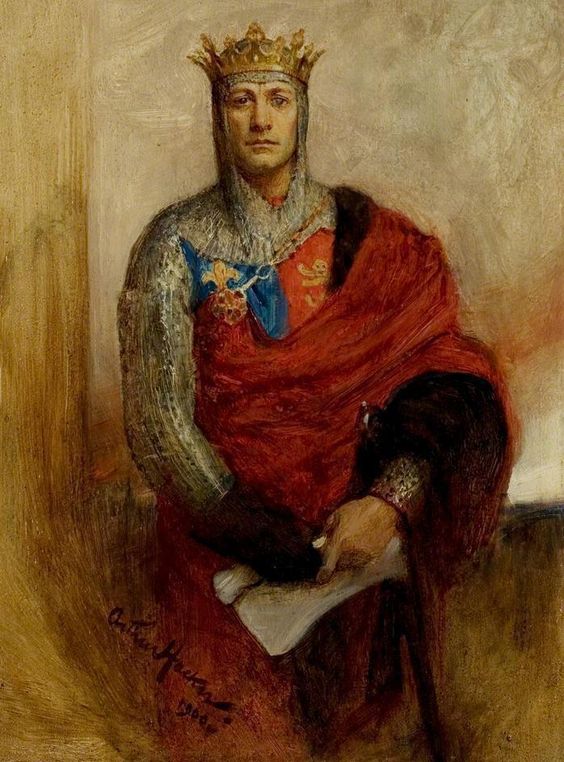
Painting of Henry V (mistaken online as King Arthur) by painter Arthur Hacker (1900).


      The History of the Kings of Britain by Geoffrey of Monmouth offers a fascinating perspective on the history of the British Isles. From the excerpts read over the past week, I was particularly struck by the alleged connection of the Britons to the defeated Trojans.  


Brutus! there lies beyond the Gallic bounds,
An island which the western sea surrounds, 
By giants once possessed, now few remain 
To bar thy entrance, or obstruct thy reign.
To reach that happy shore thy sails employ 
There fate decrees to raise a second Troy 
And found an empire in the royal line, 
Which time shall ne’er destroy, nor bounds confine.


     In linking the heroic Trojans to the earliest beginnings of the Britons, the author (supposedly recording the words of a goddess in the passage above) creates a highly unique history or back story with regards to the people of the British isles. As told by Homer, then, the descendants of heroes such as Agamemnon, Menelaus, and Telemachus live again in a certain sense within this new Troy: heroes from the beginning. Chapter 17 tells the story of the building of this new Troy on the banks of the river Thames.

Brutus, having thus at last set eyes upon his kingdom, formed a design of building a city, and with this view, travelled through the land to find a convenient situation, and coming to the river Thames, he walked along the shore, and at last pitched upon a place very fit for his purpose. Here, therefore, he built a city, which he called New Troy…

     Another interesting dimension from the book concerns the giants supposedly already residing in the Trojans' new home. As conveyed in chapter 16, the battle between Gogmagog (also called Goegmagot) and Corineus describes the giant being hurled from atop a high cliff into the sea below. "That place derived its name from the giant's fall and
 is still called Gogmagog's Leap to the present day."  Unfortunately, there is no corresponding place reportedly found within the British Isles.  The intersection of the modern with the past in geographical records is always intriguing; it's nice to have some mysteries still existing.


Monday, July 3, 2017

Brief Reflections on a "Room with a View"

     I enjoyed recently watching A Room with a View, and I look forward to reading the book by E.M. Forster. As the motion picture was released between my junior and senior years in high school, it's no great surprise that I managed to miss seeing it the first time it came around.  It's not exactly the kind of movie my group of friends would likely have enthusiastically pursued.  (In case you're wondering, other movies released in this same period included Aliens, Ferris Bueller's Day Off, Top Gun, Stand by Me, and Pretty in Pink.)


     Again, the dimension of connecting with the world around you seems to be a theme that infuses this motion picture.  Especially with regards to the first part of the movie set in Florence, Italy, there is a strong sense in which the newcomers are firmly more in the tourist than traveler column.  There is a dissatisfaction with the accommodations, for instance.  The scene in which Lucy Honeychurch observes the fight is another scene in which the reality is not so comfortable an experience with which to join.  In the romantic relationship that develops, though, we see a character slowly growing into realization of this connection with not only the present, but also with the people around her.  

     All in all, the motion picture serves as a good reminder of the need for the traveler to immerse himself in the culture and to be open to new ways of understanding and connecting with the world beyond one's own narrow borders.


Alain de Botton's "The Art of Travel" and Connecting with the Present

     The Art of Travel by author Alain de Botton offers wise words for the person preparing to depart upon a long journey.  Are we, for instance, tourists or travelers?  Is there an important distinction between the two categories?  Does it really matter?

     In my reflections upon what I have read so far of this book, it seems that the difference is one of depth of experience.  If the foreign visitor is comfortable visiting the usual spots and completing a long to-do list of sights and experiences, then perhaps the tourist label applies.  On the other hand, if the person wishes to catch the daily rhythms and feeling of a place and its people in a more complete and profound way, the term of traveller may be more applicable.  Of course, it seems to me that even the best traveller is likely to spend some time being a tourist within the same trip, and I don't see any negative dimension to this.

     One short passage from The Art of Travel that particularly caught my interest concerned a visit by the author to a service station situated somewhere between London (to the south) and Manchester, about three hours distant.  His descriptions of the eatery suggest one critical dimension of the traveler's quest: connection.  "Vast panes were held in place by strips of beige putty, into whose chewy clamminess I was tempted to dig my nails."  

     It's a simple sentence, but it expresses a desire to experience a tactile connection with the here and now, to connect with the present.  A friend of mine recently referred to this along the lines of marking time with the present in an action similar to tapping one's feet or fingers.  It's so easy to let time flow past and not take a step actively into its waters.  This element of connection seems to be one important message of this passage by Alain de Botton.

Sunday, July 2, 2017

London/Rome Study Abroad

     It's getting closer to the time of departure, and it's truly hard to imagine I'm finally going to be traveling (and learning) through London and Rome.

     In about eight weeks, I'll be leaving the USA for London along with a group of fellow student travelers from Marylhurst University.  I look forward with great anticipation to seeing the sights of two of the truly great cities of the world.  In making this journey, the focus is really upon learning and connecting the dots  regarding the cultural and physical context of some of the world's greatest art and literature.  I look forward to visiting the libraries and museums of London, and I also am excited to visit the Vatican.  The Globe Theater is also on the itinerary, and I am confident that will be amazing.  For a guy whose only out of country travel has been limited to Canada, I'm confident this will be an enriching experience for all of us student travelers.  

     This study abroad program will be the primary focus of my blog for a while now.  If you want to check for updates, I invite you to search for the following hashtag: #MULondonRome2017 .