Showing posts with label #MULondonRome2017. Show all posts

Monday, October 2, 2017

The Practical and Symbolic Resonance of Water in Ancient Rome


      A short essay exploring the significance of water to ancient Rome follows.  MLA format not strictly adhered to here due to blog formatting restrictions and general readability.


The Practical and Symbolic Resonance of Water in Ancient Rome


If we pause and think about the cycle of a drop of water as it endlessly changes its form and location, we can catch a glimpse of this Christian community: past, present and future. Perhaps this drop of water on our outstretched finger once dropped as rain on the head of Christ himself. (Erickson, Online)


     One of the great wonders of ancient Rome was its ingenious strategy for bringing fresh water into the city.  With its stunning creation of aqueducts and underground system of lead pipes, it truly was called “regina aquarium, the queen of the waters.”  (Hughes, 64)  Visitors from afar must have been astonished at the abundance of clean running water within the city.  This abundance of water was a critical factor in enabling Rome’s population to expand so freely with each passing century.  According to Robert Hughes in Rome, A Cultural, Visual, and Personal History, maintaining this flow of fresh water into Rome was a complex and daunting task.
Before it could flow out of Rome, of course, the water had to flow in.  It did so mainly through aqueducts.  Eleven of these supplied the city with its drinking and washing water, eight entering by the region of the Esquiline Hill.  Four more were added after the popes replaced the emperors, two of them in the twentieth century.  No other ancient city had such a copious supply of water…  (Hughes, 64)
Water was more than a practical necessity for Rome, however.  As its many fountains like the Fontana del Nettuno (Fountain of Neptune) demonstrate, water also played a critical part in nurturing and symbolically representing the unique creativity and passion for the arts found within Rome.  From bringing water into the city in complex aqueducts, turning dry lands into productive agricultural models, and using water for artistic purposes, there was no end of the practical and symbolic resonance of water in early Rome.

     In an excellent academic paper prepared by Evan James Dembeskey for the University of South Africa, he quotes the following passage from Pliny the Elder’s Natural History concerning the wonders of the Roman aqueduct system.  (A different translation was utilized here than the one referenced by Evan Dembeskey.)
If we only take into consideration the abundant supply of water to the public, for baths, ponds, canals, household purposes, gardens, places in the suburbs, and country-houses; and then reflect upon the distances that are traversed, the arches that have been constructed, the mountains that have been pierced, the valleys that have been levelled, we must of necessity admit that there is nothing to be found worthier of our admiration throughout the whole universe.  (Pliny, EBook)
Another remarkable passage from Pliny describes the astonishing magnitude of the engineering involved in these creations.
The channels thus formed are called “corrugi,” from our word “corrivatio,” I suppose; and even when these are once made, they entail a thousand fresh labours. The fall, for instance, must be steep, that the water may be precipitated, so to say, rather than flow; and it is in this manner that it is brought from the most elevated points. Then, too, vallies and crevasses have to be united by the aid of aqueducts, and in another place impassable rocks have to be hewn away, and forced to make room for hollowed troughs of wood; the person hewing them hanging suspended all the time with ropes, so that to a spectator who views the operations from a distance, the workmen have all the appearance, not so much of wild beasts, as of birds upon the wing. Hanging thus suspended in most instances, they take the levels, and trace with lines the course the water is to take; and thus, where there is no room even for man to plant a footstep, are rivers traced out by the hand of man.  (Pliny, EBook)
It is hard to grasp the ability of an ancient people having both the understanding and the ability to accomplish such tasks.  While this appreciation is perhaps tempered by the assumed use of slaves to perform much of the backbreaking and dangerous work, the final success remains a breathtaking feat of engineering.  More than that alone, however, the Roman water system facilitated the practical survival of a large and growing Roman population, which then permitted greater attention to be placed upon the arts as well as engineering and government, public discourse.  In other words, being relieved of some of the immediate pressures of daily survival, the culture was able to mature and flourish in a way that would not have been possible otherwise.  In a substantive way, the clean water pouring through the aqueducts and out from the many fountains was quenching a cultural thirst in the same way it addressed the immediate human need.

     While further research remains required to ascertain the critical nature of agricultural irrigation within the immediate area of Rome itself, irrigation and water rights issues were critically important in North Africa and elsewhere within the Roman Empire.  (Hollander and Spanier, 3504) If rainfall could not be depended upon for agriculture, irrigation techniques were implemented where possible.  As we see from the fountain photographs at the conclusion of this essay, however, water was for far more than practical and life-sustaining purposes alone; it also conveyed the artistic richness and beauty of the Roman Empire.  This particularly must have struck the pilgrims arriving in Rome at Piazza del Popolo.  After long and difficult journeys, the sight of so much flowing water must have been truly astonishing: both welcoming the end of physical thirst and the beauty addressing something more along the lines of the thirst for beauty and the spiritual dimension.

     If water symbolized life, then there was truly an abundance of life within the Roman Empire.  The eternal nature of water, its endless cycle of change, also seems a fitting emblem for Rome.  In one sense, the mysterious quality of water represents the many and diverse citizens of Rome, but it is more than that alone.  As mentioned previously, the abundance of fresh water led to satiation of the need for drinking and bathing water, which, in turn, created an environment a little less concerned with survival alone as the goal, opening the door to wider and richer expressions of thought and the arts.  Beauty for the sake of beauty finally became something within the grasp of the common man, and that is clearly something for which we can all be thankful.  Another important dimension of the Roman contribution to western civilization, of course, is its impressive legacy of paved roads.  Together, the water and transportation systems encouraged the spread and sharing of important ideas; this certainly includes Christianity and Living Water.


Cited and Consulted Sources

Dembskey, Evan James. “The Aqueducts of Ancient Rome.” Feb. 2009,
  www.romanaqueducts.info/aquapub/dembskey2009Rometxt1.pdf. (University of South Africa)

Elder, Pliny The. Delphi Ancient Classics: Complete Works of Pliny the Elder
       (Delphi Classics). Delphi Publishing Limited, 2011. EBook.

Erickson, Karl Bjorn. “Mysterious Tools.” America Magazine, 3 July 2006,

Erickson, Karl.  Fountain and Water Photography, 2017, Rome.
       JPEG.

Hollander, David B., and Ethan Spanier. “Irrigation, Greece and
       Rome.” The Encyclopedia of Ancient History, 2012,    
       doi:10.1002/9781444338386.wbeah06364.

Hughes, Robert. Rome: A Cultural, Visual, and Personal History.
       New York: Alfred A. Knopf, 2011. Print.


Wednesday, September 20, 2017

What a Journey!

From September 1st through the 18th, I walked about 110 miles between the United Kingdom and Italy.  Our journey brought us to some of the world's greatest museums in London and Rome as well as amazing archaeological sites in both the UK and Italy.

It was truly a life-changing experience, which has yielded so much more than I was expecting in knowledge, understanding, appreciation, and confidence.  The appreciation came to bear at each and every step--e.g. appreciation for the opportunity, etc.  At the current time, though, the appreciation is more focused on resting and enjoying being at home: a home that now feels like a palatial estate after the discomforts of travel.  With regards to the cramped living of Rome in particular, our 2-storey, three bathroom home in quiet Monmouth, Oregon is such a wonderful retreat for a few days of healing and rest.  It makes one not take daily luxuries quite for granted the same way anymore.  And, there's ice!

I was fortunate in that I really had only about half a dozen instances of what I would call trouble on this trip, but other travel companions from Marylhurst ran into some more serious issues.  My low point was getting dropped off by a Roman taxi on the wrong side of the Tiber (I think).  Even with a map and iPhone, I managed to get completely disoriented and ended-up wandering up and down the sides of the Tiber for hours until I could establish my bearings--and get a new taxi.  Another time, I left a gathering late at night with a very low iPhone battery.  Google Maps is hard enough to follow in the United States, but in Europe one must at times disregard the voice directions and pay more attention to the directional arrows; the streets aren't as standard in direction or size as found in the states.  So, imagine a thunderstorm starting at about this time with my iPhone almost out of juice.  Almost half my turns seemed to be in error, and I kept having to retrace my steps.  At one point, Google Maps advised me to turn into a dark and narrow alley that seemed like a particularly bad idea; I kept plodding ahead in the rain.  I finally made my Roman apartment, but I was soaked to the bone, and the phone was almost dead.  All in all, though, the good experiences outweighed the bad ones like this, and we all managed to get along through the end of the journey.   

I surprised even myself with my photos.  In the end, I returned with more than 5,000 photos and videos from my Canon--more with the iPhone.  After deleting a couple hundred poor photos, I flagged my favorites, then uploaded those to (public) albums on Facebook.  As I do with all my photography, all the photos--the great and not so great--are in the process of being uploaded to Flickr.  (This is my photograph backup measure with most photos identified as public, except for family pictures, but restrictions placed on the ability of the photos to be downloaded without permission.)

So, here's where you can find photos online.  I'm also planning an old fashioned slide show event for friends and family.  Contact me, if interested!

Flickr  (more photos coming)

Facebook (London)

Facebook (Rome)

Bigstock (in future)


Sunday, August 27, 2017

Arrivederci!


Depart for London: August 31
Arrive in London: September 1
Depart for Rome: September 7
Arrive in Rome: September 7
Returning Home: September 18

     The trip is starting to feel real now. I guess it had better, as I'm leaving for London in just a few days! This is a simple blog post, but it may contain helpful or interesting information relating to my upcoming journey for friends and family who want to follow along a bit on the adventure.


     It's possible I will be updating this blog as I go, but this is largely dependent upon available free time and an internet connection.  At the very least, I will stay publicly connected using social media platforms such as Twitter, Facebook, and possibly Pinterest.  (Feel free to connect!)  On social media, also keep an eye out for my photography identified with one of the following hashtags: #KarlsLondon and #KarlsRome.


LONDON, UNITED KINGDOM


Click for Live Cam


Click for Live Cam  (Savoy Place)


ROME, ITALY


SaveSave                         

Click for Live Cam (Trevi Fountain)


SaveSave
Click for Live Cam with Audio (Coliseum)

Click for Live Cam (Vatican City)

Click for Live Camera (Basilica of Saint Francis)


Links:


Courtesy "National Geographic"

Courtesy "National Geographic"


* Looking for an excellent book on Saint Francis?  Read Saint Francis of Assisi by G.K. Chesterton!


Sunday, August 20, 2017

London/Rome Study Abroad Goals & Expectations

     In just over a week now, I'll be leaving the USA for London along with a group of fellow student travelers from Marylhurst University. I look forward with great anticipation to seeing the sights of two of the truly great cities of the world. As I wrote recently about making this journey, the focus is really upon learning and connecting the dots regarding the cultural and physical context of some of the world's greatest art and literature. I look forward to visiting the libraries and museums of London and Rome, and I am particularly excited for the opportunity to spend hours upon hours at the Vatican. The Globe Theater is also on the itinerary, and I am confident that the play will be amazing. For a guy whose only out of country travel has been limited to Canada, I'm confident this will be an enriching experience for all of us student travelers.

     I selected the image above from Google Earth, because it's illustrative of how perspective influences our understanding of places.  This image may evoke a welcoming environment, but it is actually North Africa.  The shape and feel of places change as we grow nearer and assumptions are slowly replaced with familiarity.  It's my sincere hope that the upcoming trip will be illuminating in this regard for all of us travelers.

     I decided to add that I think I'm most looking forward to London.  The language barrier for Italy makes me a bit uncomfortable.  Of course, being uncomfortable is not necessarily a  bad thing.  Looking forward to what may come!


Experiencing Anthony Doerr's "Four Seasons in Rome"


     I have really enjoyed the opportunity to read Anthony Doerr's Four Seasons in Rome this term.  If Robert Hughes' book on Rome is seen as something of an objective analysis of Roman history and culture, Doerr's book is a much more subjective reading experience.  It's instantly engaging and welcoming to the reader, creating a rich sense of place with a narrative that feels often like poetry.  There is no sense of anything other than an honest account of the Doerr's family experiences in Rome: no underlying cynicism or inflated sense of ego to get between the reader and the text.  The author's gentle attitude is often expressing a profound sense of wonder not only of Rome itself, but, I would argue, his lovely family seen through the lens of Rome and the Roman people.  

     One of my favorite passages is the following excerpt concerning his son; it really captures the purity of personal experience and thought conveyed within these pages.

Swaddled in his Moses basket, wires trailing out the bottom, his monitor flashing green, green, green, his entire four-pound body motionless except his eyelids, it seemed he understood everything I was working so hard to understand: his mother's love, his brother's ceaseless crying; he was already forgiving me for my shortcomings as a father; he was the distillation of a dozen generations, my grandpa's grandpa's grandpa, all stripped into a single flame and stowed still-burning into the thin slip of his ribs.  I'd hold him at the window and he'd stare out into the night, blue tributaries of veins pulsing in his neck, his big eyelids slipping down now and then, and it would feel as if tethers were falling away, and the two of us were gently rising, through the glass, through the trees, through interweaving layers of atmosphere, into whatever was beyond the sky.

     One aspect of the book that I particularly appreciate is the author's emphasis of understanding a place through the eyes of its people.  He's not a simple tourist or traveller, he's experiencing Rome through the act of truly living there: mingling in the markets, strolling the ancient streets, speaking--or attempting to speak--with its residents, and, in short, truly living in the place.  I know my upcoming visit will be but a fraction of the length of his, but I hope I may leave Rome with a much greater sense of what this city is all about when my time comes to head home.  Like Doerr, I don't see most of this knowledge coming from being a tourist per se, but as something along the lines of a (very) short-term resident.
  

Sunday, August 13, 2017

A Short Digital Maps Project Exploring Homer's Iliad


Full many a host in line of battle rang'd My eyes have seen; but such a force as this, So mighty and so vast, I ne'er beheld: In number as the leaves, or as the sand, Against the city o'er the plain they come. Then, Hector, for to thee I chiefly speak, This do; thou know'st how various our allies, Of diff'rent nations and discordant tongues: Let each then those command o'er whom he reigns, And his own countrymen in arms array." She said; and Hector knew the voice divine, And all, dissolv'd the council, flew to arms, The gates were open'd wide; forth pour'd the crowd, Both foot and horse; and loud the tumult rose.


Before the city stands a lofty mound, In the mid plain, by open space enclos'd; Men call it Batiaea; but the Gods The tomb of swift Myrinna; muster'd there The Trojans and Allies their troops array'd. 

The mighty Hector of the glancing helm, The son of Priam, led the Trojan host: The largest and the bravest band were they, Bold spearmen all, who follow'd him in arms. Anchises' valiant son, AEneas, led The Dardans; him, 'mid Ida's jutting peaks, Immortal Venus to Anchises bore, A Goddess yielding to a mortal's love: With him, well skill'd in war, Archilochus And Acamas, Antenor's gallant sons.

Homer. The Iliad (Kindle Locations 548-556). Public Domain Books. Kindle Edition.


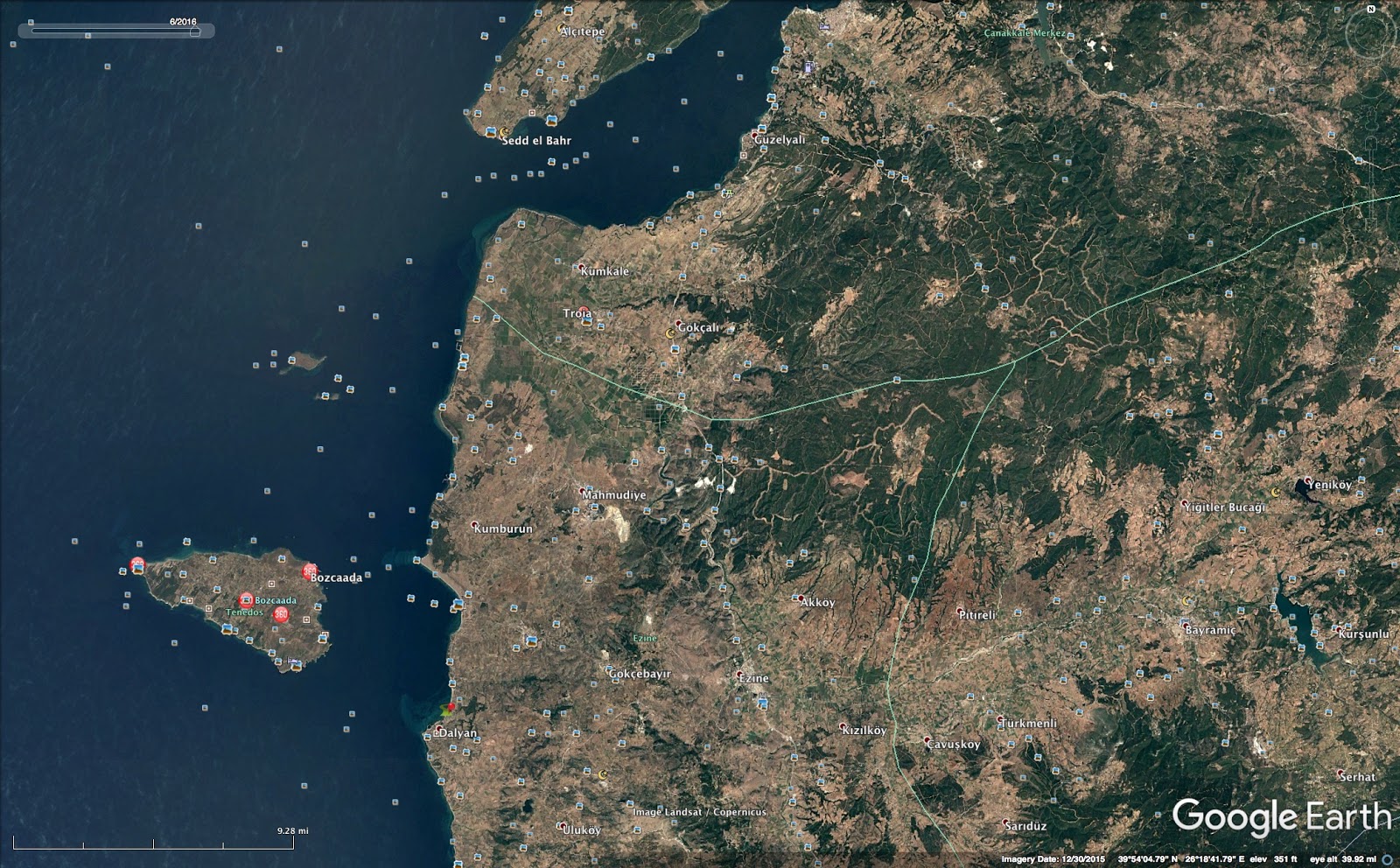
     After reading the passage above, observe the geographical features of the ancient city of Troy itself from Google Earth.  (Today referred to as Troia, Turkey.)  The second photo is from April 2016, and I have included it because of the illumination it provides of the potential fertility of the area.  With regards to the passage, pay particularly close attention to the second paragraph.  If you look carefully at the images, you can clearly see the rise or mound upon which the city rested, more secure in this vantage point from approaching enemies.  The third image provided is a more distant view of the area from above to convey greater context.


     The following image conveys a sense of the great journey Odysseus took by ship to reach Troy from Ithaca—and, of course, the much longer journey home. 


     The image directly above, courtesy OpenCulture.com, displays the hometowns of the cast of characters from the Iliad.  It has been pointed out by others, however, that most of the women—including Helen—have not been included.  


     While it may never be known whether, or not, Odysseus was based upon a real man, myths have a way of solidifying around that kernel of truth.  Since Troy has been demonstrated as having existed, perhaps there is more truth than fantasy to Homer’s epic works.  If so, these journeys represent an astonishing accomplishment for the period.

Saturday, August 12, 2017

Christianity Before Emperor Constantine

     Early Christianity under Roman rule suffered unspeakable cruelties and acts of barbarism by the Roman authorities.  In order to understand the deeper conflict, it's helpful to take a step back to understand the historical context with more clarity.
     The following passage from Robert Hughes' Rome examines the Christian understanding of what it meant to be living in what they were certain represented the end times.  (See the 24th chapter of the Gospel of Matthew.)

Christianity did not believe that such prophecies, promises, and threats were in any way metaphorical. They were truthful in essence, and soon would be in fact as well: not in the distant future, but imminently, within this generation. Rome was doomed to be destroyed in a few years, in a few decades at most. The New Testament had not been written yet, but such beliefs were preached, described, made part of the essential public lore of the new religion and its adherents. To them, it made perfect sense, because it was Revealed Truth. But it also made sense to the Roman authorities, sense of a different kind. It meant that the Galileans wanted this promised destruction...

     The last couple sentences are a little bit of an eye opener for me. It doesn't, of course, excuse any of the Roman persecution or brutality, but it demonstrates at least a pretext of rationalization--rather than simple sadism and evil. To make an aside here, I think it's worth pointing out that different emperors held different levels of tolerance for the Christians. Madness and vile hatred clearly fueled Nero's attack upon them, for instance, but others weren't quite so ferociously intent on murdering them; they didn't understand the new and mysterious sect.

     Speaking of Emperor Nero, I encourage you to read Father Bruce Vawter's short book, Revelation: A Divine Message of Hope. It does a splendid job exploring the religious and symbolic context of the book of Revelation, demonstrating it as an important offer of hope for the early persecuted Church. I also suggest that passages such as Mark 13:32 and the issue of the Second Coming potentially reveals an incredible insight into the humanity of Christ. Was there, for instance, a lack of intimate knowledge visible in chapters such as Matthew 24? Did Christ Himself believe the Second Coming was coming within a matter of years? He might have been speaking metaphorically, but, either way, it offers a fascinating insight into the mind of Christ.

     Returning to the main topic of exploration here, I think it's also helpful to read the following excerpt from a letter of reply from Emperor Trajan to Pliny the Elder. This is taken from The Great Documents of Western Civilization by Milton Viorist, a wonderful Christmas present from my late uncle Phil Rand.

You have adopted the proper course, my dear Secundus, in your examination of the cases of those who were accused to you as Christians, for indeed nothing can be laid down as a general ruling involving something like a set form of procedure. They are not to be sought out; but if they are accused and convicted, they must be punished--yet on this condition, that whoso denies himself to be a Christian, and makes the fact plain by his action, that is, by worshiping our gods, shall obtain pardon on his repentance, however suspicious his past conduct may be. Papers, however, which are presented unsigned ought not to be admitted in any charge, for they are a very bad example and unworthy of our time.

I'd like to particularly draw your attention to that last sentence, which I've highlighted here. This is yet another example of the importance of the rule of law to the Romans; even the Christians had rights--well, before some emperors, at least.


Painting by Peter Paul Rubens

Sunday, August 6, 2017

The Magic of Concrete

"Italy Sulmona view of the Roman aqueduct with the Del Vecchio fountain in the foreground"


In the fourth chapter of Robert Hughes' Rome, A Cultural Visual, and Personal History, my attention is drawn to the historic architectural breakthrough of concrete.

With concrete, the Romans could build aqueducts, arches, domes, and roads; it opened up means of rapid transport, storage, and defense that had not existed in earlier masonry cultures. Concrete built hundreds of bridges, which gave the Roman army swift access to the most remote parts of the Empire. The stuff of power and discipline--it was ugly and always would be--the brief mid-twentieth-century vogue for beaton brut, produced some of the most hideous, grime-attracting surfaces in all architecture, as a visit to London's Festival Hall will confirm. But it could be rendered with stucco or faced with thin sheets of stone, and it was very strong and cheap, allowing the the construction of very large structures.


Hughes, Robert. Rome: A Cultural, Visual, and 

     Personal History. New York: Alfred A. Knopf,
     2011. Print.

(Illustrative links added for blog; they were not selected by Hughes.)


It's hard to believe that something as ugly and "ordinary" as concrete could have such an effect upon history, but it certainly made its mark. In the prior post, for instance, I endeavored to focus upon the significance of the abundant fresh water in Rome, and this would have been impossible without the concrete aqueducts. It was, in effect, the bridge between thought and idea and reality: the malleable stuff of emperor's dreams.

     As a fellow who has to work in one of those concrete government buildings, I'm a little ambivalent about my topic of choice here. Still, it seems this was one of the materials or tools that really enabled Roman culture and genius to thrive. (As John D. Spalding observes in his essay "Spreading the Word," from Heldref Publications, the Roman system of roads also greatly facilitated the spreading of the Gospel.)

Monday, July 31, 2017

Sunstone and Fountains

     In the prologue of Robert Hughes' book on Rome, he quotes the opening lines from Octavio Paz's poem entitled "Piedra del Sol."  Here is the passage in both English and Spanish.
     In part, I think the poem's resonance with me centers on the way it begins to catch and convey the mysterious nature of flowing water. The shapes it reveals, the endless eddies and currents, reflect a mysterious quality when viewed closely; it is never the same twice.  With regards to the study abroad posts, I intend to continue to focus upon water in its symbolic as well as its life-giving nature.


SUNSTONE THE POEM

Sunstone | Octavio Paz

willow of crystal, a poplar of water, 
a pillar of fountain by the wind drawn over, 
tree that is firmly rooted and that dances, 
turning course of a river that goes curving, 
advances and retreats, goes roundabout, 
arriving forever: 
the calm course of a star 
or the spring, appearing without urgency, 
water behind a stillness of closed eyelids 
flowing all night and pouring out prophecies, 
a single presence in the procession of waves 
wave over wave until all is overlapped, 
in a green sovereignty without decline 
a bright hallucination of many wings 
when they all open at the height of the sky...

PIEDRA DE SOL

Piedra de sol | Octavio Paz

Un sauce de cristal, un chopo de agua, 
un alto surtidor que el viento arquea, 
un árbol bien plantado mas danzante, 
un caminar de río que se curva, 
avanza, retrocede, da un rodeo 
y llega siempre: 
                      un caminar tranquilo 
de estrella o primavera sin premura, 
agua que con los párpados cerrados 
mana toda la noche profecías, 
unánime presencia en oleaje, 
ola tras ola hasta cubrirlo todo, 
verde soberanía sin ocaso 
como el deslumbramiento de las alas 
cuando se abren en mitad del cielo...


Sunday, July 30, 2017

Roman Draining of Fucine Lake

     
     One of the great wonders of ancient Rome was its ingenious strategy for bringing fresh water into the city.  With its stunning creation of aqueducts and underground system of lead pipes, it truly was called “regina aquarium, the queen of the waters.”  (Hughes, 64)  Visitors from afar must have been astonished at the abundance of clean running water within the city.  This abundance of water was a critical factor in enabling Rome’s population to expand so freely with each passing century.  According to Robert Hughes in Rome, A Cultural, Visual, and Personal History, maintaining this flow of fresh water into Rome was a complex and daunting task.

Before it could flow out of Rome, of course, the water had to flow in.  It did so mainly through aqueducts.  Eleven of these supplied the city with its drinking and washing water, eight entering by the region of the Esquiline Hill.  Four more were added after the popes replaced the emperors, two of them in the twentieth century.  No other ancient city had such a copious supply of water…  (Hughes, 64)

It is indeed strange and disturbing to pause a moment and consider that Rome’s water system before the time of Christ was arguably a better system than currently available today in impoverished areas of the United States—e.g. the Navajo of northwestern New Mexico.  (NPR, web)  Clean water, it seems, is something so quickly taken for granted by western civilization, but the development of a rich culture and learning is inseparably tied to its availability.

     One of the most impressive examples of aqueduct engineering in ancient Rome must be the draining of Fucine Lake in the time of Emperor Claudius (10 B.C.E-54 C.E.).  (Hughes. 102)  As visible in the map below, note the great distance between Rome and this lake to the northeast.  (Click for a larger view.)


Information available from NASA’s website reveals just how great a feat of engineering this truly was.

…Emperors Claudius and Hadrian achieved limited draining of the original lake—to control both flooding and malaria—by digging and then expanding a tunnel through the hills near Avezzano at the top of the image. Claudius used 30,000 workers over a span of ten years to dig the 5.6-kilometer-long tunnel. This engineering work reduced the size of the lake from an original area of about 140 square kilometers to about 57 square kilometers. (NASA, web)  


     The momentous act of tunneling these drainage lines through a mountain and hills, constantly having to be aware of complex issues such as slope and grade as well as natural barriers, and without the benefit of modern equipment is an awe-inspiring accomplishment.


The canal by which the water should be conveyed away, was to be formed in part by a deep cut, and partly by a tunnel through a mountain; and inasmuch as in those days the power now chiefly relied upon for making such excavations, namely, the explosive force of gunpowder, was not known, any extensive working in solid rock was an operation of immense labor.  (Abbott, 64)


     Of course, the loss of life in these public works projects must have been horrible—especially when one considers that most of the labor was done by slaves. Robert Hughes observed that the draining of Fucine Lake “almost proved a disaster; because of a miscalculation by the engineers, the lake waters came rushing out too soon and backed-up in a too-narrow sluice, nearly drowning Claudius and his party, for whom a great banquet had been prepared on the bank of the channel.” (Hughes, 103) If accidents like this happened even to the emperor, then one can only guess at how often death and permanent injury befell the exploited laborers upon these projects. Besides the gold and treasure required to fund immense public works projects such as this, it is also true to say that they were paid for in the blood, sweat, and tears of the workers and slaves who toiled each day to bring these grand visions to reality.


Cited Sources

Abbott, Jacob. History of Nero ... With Engravings. New York: n.p., 1867. Print.

Hughes, Robert. Rome: A Cultural, Visual, and Personal History. New York:
       Alfred A. Knopf, 2011. Print.

"Lake Fucine, Italy: Image of the Day." NASA. NASA, n.d. Web. 30 July 2017.

Morales, Laurel. "For Many Navajo, A Visit From The 'Water Lady' Is A
       Refreshing Sight." NPR. NPR, 06 Jan. 2015. Web. 30 July 2017.