Saturday, November 12, 2011

Father Tim Mockaitis' Audio Interview

Fr. Tim at blessing of Kimberly's gilded frames.
This morning's in-person interview of our priest, Father Tim Mockaitis, may prove to be one of my favorites.  It was really more of a far-ranging conversation than a typical interview, exploring everything from his book, The Seal, concerning the 1996 surreptitious recording by the Lane County Prosecutor of a prisoner's sacramental confession to the larger issues regarding this sacrament as well as the morality of the death penalty--and even touching upon the thorny issue of Pro-Choice Catholic politicians.


It had my intention to transcribe the entire interview for the purpose of this post, but I came to the conclusion that this would actually make it less engaging an experience.  I suggest that you listen to the entire interview, but I also will include some time markers--in case you want to quickly listen to particular sections and return later for the rest.


Since it wasn't my initial intention to use the audio, it's been necessary for me to do quite a bit of editing via Apple's Garage Band software.  I've removed a few of our topic digressions--as well as some of my throat clearing, and even some of my "is it recording?" episodes.  All things taken into account, though, the sound is pretty good for a simple iPhone recording.  Way to go Apple!


Again, thank you to Father Tim for taking an hour out of his busy morning to answer these questions in such a thoughtful and personal way.  I hope you enjoy this month's interview as much as I enjoyed making it!


1.  What warning should all Christians, and Catholics in particular, take from the egregious taping of this Sacrament of Confession on April 22, 1996 by the Lane County Prosecutor's Office?

2.  When did you decide that you needed to write The Seal?  (4 minutes and 10 seconds) 


3.  To the best of your knowledge, does this tape still exist as evidence in the Lane County Sheriff's Office?  If so, how does this make you feel?  (8 minutes and 20 seconds)
4.  Has this experience helped form your personal belief concerning the morality of the death penalty? (13 minutes)
5.  If the opportunity to read a taped confession were to come about within a publication such as a newspaper, do you believe that a Catholic's reading of the immorally-taped confession constitutes a serious sin?  (38 minutes and 20 seconds)

6.  For the most heinous murderers, do you see a sense in which it acts as a mechanism of self defense for society at large?  In other words, these people will never escape or be released in error to murder again.  (15 minutes and 20 seconds)  
7.  I don't know the statistics, but it seems that the Sacrament of Confession is being ignored by more and more Catholics.  Have these numbers indeed fallen over the last few decades?  If so, why do you think more people don't highly value Reconciliation?  (18 minutes and 30 seconds)
8.  When did you decide you wanted to be a priest?  In a related vein, did you have a particular moment as a younger man where you experienced a second conversion, a conscious turning towards Christ?  (As a family of former Evangelical protestants who crossed the Tiber in 2005, this question is always of interest to me.)  (23 minutes and 55 seconds)
9.  Who would you say are some of your favorite authors and why?  (29 minutes and 55 seconds)

10.  In a few words, what are some of the top challenges you think are currently facing the Catholic Church?  (32 minutes and 15 seconds)

(Click Here to listen to interview.)


Tuesday, November 8, 2011

What I Learned From Meeting Brian Jacques

Several years ago, I had the opportunity to briefly meet Brian Jacques (June 1939 - February 2011), acclaimed author of the Redwall series.  I recall he was particularly fond of an illustration of my wife's which was on our business cards at the time.  While talking with him for a few minutes was great, what I really took away from the evening was his talk on writing for children.  One item that stuck with me concerned his response when he was asked about whether, or not, he read books similar to his own: the competition.  He replied that he avoided doing so.  It was his worry, he explained, that doing this might unconsciously influence his own characters and the originality of their adventures.  That was the degree to which he cared about safeguarding his own originality.

Granted, it may be much easier for an extraordinarily popular writer to avoid mixing with the competition than for the rest of us more average writers, but I think there’s a message here for all of us.  Of course, not everyone agrees with this view.  One literary agent I met in Seattle took the position that it’s a mistake if the writer fails to immerse himself in his own genre, and it is true that writers should to be able to intelligently compare their work to the competition.  Still, as I said, I think there’s more truth than error in Mr. Jacques’ position.

I irritate my family to no end at times, because of the ways I try to implement this wise advice.  If there’s a movie that comes too close to my writing for children, for instance, I’ll avoid going—unless seriously outvoted.  It seems to me that there’s a general apathy to originality in the creative marketplace of today.  Sometimes, we mistake originality with simply “being different,” but it’s more than that.  
One example, a personal pet peeve, that comes to mind is the tendency for more and more authors to try to re-write classic works with their own modern spin.  While I have seen this work artistically a few times (and commercially more times), it too often makes the reader only too aware of how much better the classic actually is.  This holds even more true when the author betrays ignorance concerning the original work. 
If we look at these re-writes, in particular, we’re likely to hear several explanations or excuses from their producers—it introduces younger readers to the classics, satisfies public appetite for this style of writing, or, hey!, there’s only so many plots from which to choose!  Broadly speaking, I think the first position is the most tenable, but none is convincing to me.  In my mind, it’s still a symptom of the larger disease of creative apathy.  If you’re a writer, do your job!  Create your own memorable characters, settings, and plots from scratch.  An example of a re-write work along these lines might be Pride and Prejudice and Zombies.  Of course, this is just my personal opinion, and there are clear exceptions--for example, the great movie Oh Brother, Where Art Thou? as inspired by Homer’s Odyssey.  

To digress into a bit of a philosophical vein here, if creativity and originality are likened to a pool from which successive generations of artists, writers, and composers draw their inspirations, I’d have to say that the water has become somewhat shallow of late.  Mysterious places and phenomenon of our planet are regularly unmasked by science.  Each stone that is turned over in pursuit of science is one less stone under which the fairy may fly—to put it in romantic terms.  (I can imagine my late uncle Phil Rand cringing at this expression of sentimentality.)  It's not that I'm lamenting "progress" exactly, but I'm suggesting there's a downside, too.  The more we come to know, the less mystery or unknown there is in the air, and it's that sense of mystery and adventure which has inspired some of the West's greatest books.


I’d also take the position that unique experiences of individuals from which creative work is born or nurtured has been lessened to some degree by shared media, shared experiences.  Instead of experiencing our own adventures, we are content to watch and listen to those of strangers.  All of these things—from the felling of the forests to the flickering television in our living rooms—seem to have drained the pool of creativity bit by bit.  Of course, there’s always hope, because God is the greatest source of real inspiration.  In conclusion, I'd like to end with the words of my father-in-law, John Collier.  


Five hundred years ago if you wanted to hear the greatest words being spoken, see the greatest sculpture being carved, see the greatest painting and hear the best music, you went to church. 


Wednesday, November 2, 2011

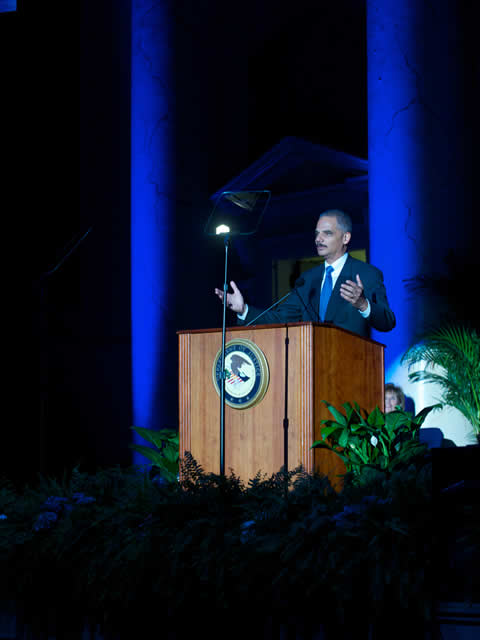
Eric Holder Needs to Go!

Back in the early 1990s, I was seriously considering a job in federal law enforcement.  To this end, I spent most of a shift riding-along with a US Border Patrol Agent out of the Blaine Sector field office.  To say that it was interesting work would be a big understatement.  

These officers are impressive in their knowledge of law enforcement practices as well as very complex immigration law and, of course, they must be fluent in Spanish.  Their daily work is both dangerous and challenging--both mentally and physically.  Although my career ultimately took me in a different direction of service, I have great respect for those who wear the badge of Border Patrol or Customs Agent.  It can be an incredibly difficult and risky job, and they deserve all the support we can give them.
This is precisely why it's so important for the Obama Administration's Attorney General Eric Holder to waste no further time in submitting his resignation.  As I tweeted on October 10th,"Fast and Furious suggests that Eric Holder was either (a) a disconnected manager or (b) untruthful in his recent testimony--or both."  The fact that Fast and Furious was such an inane endeavor is bad enough, but that Mr. Holder appears to be lying about what he did and did not know about the ill-conceived gunrunning seals it--he needs to hit the road.

According to news reports, guns from this program are linked to the death US Border Patrol Agent Brian Terry and also at least one attack on two Arizona police officers.  The guns have also found their way  south to Mexico where they were recently discovered in the residence of an arrested drug cartel kingpin.  This being the case, they have undoubtedly been used to kill men, women, and perhaps children in the cauldron of violence which Mexico has become.  One must ask, therefore, what responsibility does the US bear for the use of these weapons within Mexico?  While there may not be legal responsibility or liability, the moral culpability is unquestionable.

On May 3rd, Eric Holder testified before the House Judiciary Committee that he  "...probably heard about Fast and Furious for the first time over the last few weeks."  As widely reported, Holder now appears to have been much more in the communication loop than he has previously disclosed.  As suggested earlier, the (unlikely) prospect of him being blissfully unaware altogether would betray such an unfathomable lack of organizational leadership, that it wouldn't really put him in a better position; it's a lose or lose scenario.  The evidence at this point, however, clearly suggests that Mr. Holder was deeply ensnared in this illegal and profoundly foolish gunrunning operation.  

I'd also argue that this kind of ill-conceived and strange thinking is also evident in some of Mr. Holder's other official actions.  Who, for instance, can forget his bewildering approach to the Black Panther Voter Intimidation case from 2008?  This is an individual who appears to be using his public office to further his disturbing personal agenda.

In honor and respect of the US law enforcement officers and their families who have suffered tragedy because of these weapons as well as the innocents killed or maimed in Mexican drug violence, and the whistle-blowers such as Agent John Dodson, it's high time that Attorney General Eric Holder resign his post effective immediately.  


..."Dodson just about came apart all over them (his supervisors). In a 'screaming match' that was heard throughout the Phoenix office by many employees, Dodson yelled at Voth and Assistant Special Agent in Charge George Gillett, 'Why not just go direct and empty out the (ATF) arms room?" (to the cartels), or words to that effect.' 

(Fox News, September 26, 2011)

Saturday, October 29, 2011

Pet Peeves Revisited

Some things just bear repeating.  I've touched on this issue before, but...sometimes a week comes along where all you can do is just laugh at the foolishness of it at all.  Whether we're talking free book seekers, magazine editors who seek donated articles only to turn around and try to sell them online, or the classic dysfunctional committee, daily annoyances can get the better of us if we're not careful.


As I said in the earlier post, sometimes some quiet reflection helps to quietly put things in perspective.  In addition to trying to offer up our daily struggles to God, it also helps to see the humor in daily life.  When you feel like your pet peeves are overpowering you, just imagine what your neighbor probably thinks of you--and smile.  When all else fails, pink flamingos on their lawns are always a good alternative...

Sunday, October 23, 2011

A Technical Digression / Resetting iPhone Password

I recently inherited an iPhone 4, and I had no idea how to change its Apple password--necessary to install updates and acquire new applications.  I stopped by to ask at the local Mac Store, and the young clerk assured me that it couldn't be done.  That being the case, I thought I'd explain how simple it was to actually do.  I'm doing this for people like myself who find a legitimate need to do this, but I'll also end with some suggestions to improve overall device security.


I'll begin with mentioning that the relative from whom I inherited this device left no password information, except a few cryptic security phrase notes in his wallet and a couple references to password reset when I searched the iPhone itself.  He was a security expert, so I didn't have much hope in coming up with the correct password through trial and error.


When attempts to crack the password the traditional way were unsuccessful, I eventually received a message inquiring whether, or not, I wanted to reset the Apple password.  I indicated that I did and, since his e-mail still resided on the device, I requested to reset the account using his e-mail.  The e-mail arrived moments later, and I created the new password.  That was indeed thankfully easy.


Bear in mind that the Apple password is not the same as the pass code or screen lock.  Fortunately, this iPhone had no screen lock, or my job would have been much more difficult.  On earlier iPhones, however, this can be broken by selecting emergency call from the lock screen, then navigating away.  I don't know whether this particular vulnerability remains in the later models.    


Should you wish to make your iPhone more secure, you may wish to consider requiring a screen pass code.  In addition, I recommend registering your device through Aps such as Find iPhone.  


If you have many electronic devices on which you've stored important family information and records, it's strongly recommended that you retain your passwords somewhere with the rest of your important papers.  Should something happen to you, it makes the settling of your affairs a little simpler.


(By the way, changing the device name can easily by right-clicking on it within iTunes.  I suggest also that you create a new Apple id, then sign-out of the old, and sign-into the new.)


Wednesday, October 19, 2011

Interview of Carlos Espinosa (Holy Wood Acting Studio Founder)

Max, StellaMaris, Karla, and Carlos Espinosa

Today's interview features Carlos Espinosa, founder of the Holy Wood Acting Studio in Los Angeles.  He offers a unique and fascinating look into what it means to be an actor and artist for God in today's world.  Thank you very much, Carlos, for taking the time to answer these questions so honestly! 


1.  What can you tell us about Holy Wood Acting Studio?  What do you see as its mission?

Even if they not know it, actors are called to be leaders.  Leaders tend to be the center of attention which is a huge peril for them and his/her followers if the first are not properly instructed and trained. We can see the devastating effects on many actors after they have just a little success doing what their vocation is telling them to do. An actor that fulfills his call in its entirety would be guiding the audiences to the light, to a happier life towards God. This is the mission, to train future actors to be torches of light to the world and by that being the happiest persons on earth.


2.  What prompted you to start the business?  How is your faith reflected within this vocation? 

My son Max worked for an actor and they were always approached by many who wanted to be actors and actresses but didn't know where to be trained. We saw that there is no place anywhere that trains actors (or any other activity) that forms the person before the actor, so we did it and trough prayer and discernment; a very effective program was created.


3.  Has the field and business of acting changed a great deal in the last twenty years, or has it remained much the same--as everything around it has changed? 

Acting has been a magnet for people who understand its immense power to guide masses. So, this God given craft has changed and developed into a more driven ability and its artist must convey a message that most of the times is not the best for the families and the world. 


4. There seems to be a tendency among some Christians to look at the field of acting and drama with suspicion.  Why do you think actors are often negatively stereotyped by those of faith?  What can be done about this? 

Holy Wood Acting Studio is the answer to their prayers, because God keeps giving His children His own power to create beauty and fill the hearts of many with hope and joy but up until today there was no other place where a talented person could get a proper training to avoid the cause of that rightful suspicion which is the dangers of bad-managed fame, power and money. 


5.  Being a great actor isn't enough for the successful performer these days.  He/she also needs to be an expert promoter, business person, negotiator, etc.  Do your students sometimes question the value of learning those kinds of life and business skills necessary to achieve (and maintain) success later in their careers? 

If a future actor wants to succeed, he needs to know how to move and effectively ascend the ladder of the hard world of acting, and he needs to know it as much as the best (or more).  The business of acting is one of many of our classes and each and every one of the teachers and coaches are not only experts in coaching, but also have worked many years in the movie industry. Passion, is a must and that is our fuel so needed for the talented one also.

6.  I interviewed Sean Astin last summer, and one of the things he remarked on was the thankfulness he has just to find good work.  It seems that an actor's life is often feast and famine.  If this is true, how do you teach a student to prepare for periods of professional and private hardship? 

Personal Growth and Development is a class that teaches them how to love themselves as much as God loves them, and that is the key to have a sound and really strong confidence. When you have that, you not only never worry for the mountain of rejections you may face, but you feel that those, and all the problems they may encounter, are but a preparation for a greater mission.  The bigger the challenge, the greater the mission, and you experience that He, Your Father provides all your needs (including difficult exercises of faith, hope and love, of course).

7.  Was there a particular point in your life where you made a conscious decision for Christ, a "Second Conversion?"  (As converts from the Evangelical tradition, this is an area of interest.  I'm going to try to usually ask this question in the future interviews.) 

My wife and I were rescued by Jesus for a second time (from being lukewarm Catholics) and by the Grace of God His Spirit grants us His passion of Love for Jesus almost 20 years ago. My son Max and daughter Karla have had their own passioned affair with Our Lord and God Jesus.


8.  Technology has so changed the face and voice of media over the past decade, or so.  What do you see as some of the greatest challenges for actors in coming years? 

I see that if an actor focuses his/her life in a disciplined life of prayer and study, the effect of the technology which is so great especially on un-educated people will be used by them to make a bigger success for Jesus, for them, for their families and the for the world.

9.  Is there a saint or two for whom you share a special affinity or appreciation? 

We try to see Our Lady in the same way Jesus was seeing Her when He was a baby... totally dependent, abandoned, and confident on Her. St. Padre Pio makes his rounds of checking everyday though...


10.  Has your friend Jim Caviezel ever stopped by Holy Wood Acting Studio to talk or work with students?  Are there well-known actors and actresses involved in the process?  What do you think about actors as role models? 

I met Jim only once in a dinner party, and he hasn't come (yet) to our facility.  The culture of celebrity is way too strong to even grasp by our minds, so we try not to look for it nor depend upon it for our support. If an actor wants to endorse us, it's is a blessing, but if not we know that we always count with the full support and love of the Only Real Celebrity.


11.  What would you say is the hardest thing for your students to learn or accept? 

Humility (the hardest for me too!), which we understand it as the source of real power and real authority over ourselves and over others. 


12.  Suppose that there is a young man or woman reading this who would love to pursue an acting career, but they don't know where to begin.  What advice would you offer them today? 

To read every page of our web site where everything is explained in detail and to call 310-428-6165 for further information, but before that... to pray, pray, pray!!! 

Tuesday, October 18, 2011

Internet Ramblings

Ever thought about how the internet has changed communication?  I don't mean speed.  We all know it's fast, but what's the tradeoff for that blazing speed?  Take the publishing field, for instance.  It's very common to send an e-mail to an editor or fellow writer and for the response to take so long (if at all) that one almost forgets what the original question was about.  If you're like me, non-responses are a pet peeve.  In my day job, they are easy enough to understand, but I tend to be more irked by them as a writer.  (Suggestion of the day, use an "out of office" automatic reply to tell senders when to expect a response.  It's courteous and informative.)


The thing is, though, that more than likely the person can't manage their e-mails and Farmville simultaneously.  So, while we let petty annoyances build over such silly things as unanswered e-mails, there's probably a good chance the person hasn't even seen the message--or whatever else you may be waiting for the person to address.  For all you know, then, there is no reason at all to let yourself be annoyed by it.  Want to feel better?  Just imagine the fellow staring blankly at a growing e-mail inbox.  It works for me.   (Pink flamingos on their front lawn are also always a nice touch.)


I know I've trudged along some of this dusty trail before with the "Connection Illusion," but the internet's effect upon how we communicate greatly interests me.  I don't know the statistics, but the anecdotal evidence certainly suggests that writing quality for students within the halls of higher education is becoming poorer.  Between e-mail, instant messaging, and Facebook, it seems that it's hard to write is a decent sentence it is.  LOL.    (Joke, people.)  


Researching topics is another interesting area.  Do young people even know how to write a research paper without the internet?  I know when I looked it up on Google, it said that...  Oh, never mind.

Anyway, that's it for today.  Sorry it was such a rotten post, but I have to check my Facebook.

Update:  Please visit my friend's Deborah King's blog on this general issue, too.  See also "Why I Left Facebook."