Sunday, September 24, 2017

The Joy of Salvation as Reflected in the Arts

St Sebastian receives the crown and palm of martyrdom by Cerchia di Girolamo Siciolante (1570s)

...The jongleur was properly a joculator or jester; sometimes he was what we would call a juggler.  This is the point, I imagine, about the tale of Taillifer the Jongleur at the Battle of Hastings, who sang the death of Roland while he tossed up his sword and caught it, as a juggler catches balls.  Sometimes he may have been even a tumbler; like the acrobat in the beautiful legend who was called the "Tumbler of Our Lady," because he turned head over heels and stood on his head before the image of the Blessed Virgin, for which he was nobly thanks and comforted by her and the whole company of heaven.  

--Saint Francis of Assisi, G.K. Chesterton   

     A challenging question arose among from of my traveling companions as we explored the Vatican Museums a few weeks ago.  Why, he asked, were the faces of the martyrs and saints so sad?  Where was the joy of salvation evident?  The preceding Chesterton quote reminds us of the way in which joy should infuse our salvation.  Passages such as 1 Peter 1:3-9 also convey a sense of this joy.


Blessed be the God and Father of our Lord Jesus Christ! By his great mercy we have been born anew to a living hope through the resurrection of Jesus Christ from the dead, and to an inheritance which is imperishable, undefiled, and unfading, kept in heaven for you, who by God’s power are guarded through faith for a salvation ready to be revealed in the last time. In this you rejoice,[b] though now for a little while you may have to suffer various trials, so that the genuineness of your faith, more precious than gold which though perishable is tested by fire, may redound to praise and glory and honor at the revelation of Jesus Christ. Without having seen[c] him you[d] love him; though you do not now see him you[e] believe in him and rejoice with unutterable and exalted joy. As the outcome of your faith you obtain the salvation of your souls.

Of course, joy is also reflected very clearly within the Psalms of David.  Take a look, for example, at Psalm 71:22-24.  

22 
I will also praise thee with the harp

    for thy faithfulness, O my God;
I will sing praises to thee with the lyre,
    O Holy One of Israel.
23 
My lips will shout for joy,
    when I sing praises to thee;
    my soul also, which thou hast rescued.
24 
And my tongue will talk of thy righteous help
    all the day long,
for they have been put to shame and disgraced
    who sought to do me hurt.

     So, we see that the Bible is hardly lacking in expressions of joy and gladness.  (Of course, laughter also plays an important part.)  Why, then, does the art of the Vatican Museums seem to strongly reflect a more somber or serious level of faith?  If you take a look at the painting above as a single example, then read the 1st Chapter of Philippians, the answer begins to become a little clearer.  Bear in min, however, that the answer is more complicated than these dimensions alone might suggest.  For example, as in the case of Carvaggio, it was not uncommon for the Church to refuse acceptance of paintings that failed to meet expectations--e.g. there was financial safety in not attempting a new or provocative style.  It's also worth pointing out that the persecution of Christians by Rome certainly must have felt closer, more immediate, than it does today.  (emphasis added below)


15 Some indeed preach Christ from envy and rivalry, but others from good will. 16 The latter do it out of love, knowing that I am put here for the defense of the gospel; 17 the former proclaim Christ out of partisanship, not sincerely but thinking to afflict me in my imprisonment. 18 What then? Only that in every way, whether in pretense or in truth, Christ is proclaimed; and in that I rejoice.

19 Yes, and I shall rejoice. For I know that through your prayers and the help of the Spirit of Jesus Christ this will turn out for my deliverance, 20 as it is my eager expectation and hope that I shall not be at all ashamed, but that with full courage now as always Christ will be honored in my body,[e] whether by life or by death. 21 For to me to live is Christ, and to die is gain. 22 If it is to be life in the flesh, that means fruitful labor for me. Yet which I shall choose I cannot tell. 23 I am hard pressed between the two. My desire is to depart and be with Christ, for that is far better. 24 But to remain in the flesh is more necessary on your account. 25 Convinced of this, I know that I shall remain and continue with you all, for your progress and joy in the faith, 26 so that in me you may have ample cause to glory in Christ Jesus, because of my coming to you again.


     I decided to run this question by my father-in-law, religious artist John Carroll Collier, and he offered the following words.  "Sorrow and joy are inseparable in Christianity.  The greatest joy resulted from the greatest sorrow; we were saved by the death of Christ.  This joy and sadness must always be bound together in our faith."


For further reading, see the Catechism of the Catholic Church.

1028 Because of his transcendence, God cannot be seen as he is, unless he himself opens up his mystery to man's immediate contemplation and gives him the capacity for it. The Church calls this contemplation of God in his heavenly glory "the beatific vision": 
How great will your glory and happiness be, to be allowed to see God, to be honored with sharing the joy of salvation and eternal light with Christ your Lord and God, . . . to delight in the joy of immortality in the Kingdom of heaven with the righteous and God's friends.

SaveSave

Wednesday, September 20, 2017

What a Journey!

From September 1st through the 18th, I walked about 110 miles between the United Kingdom and Italy.  Our journey brought us to some of the world's greatest museums in London and Rome as well as amazing archaeological sites in both the UK and Italy.

It was truly a life-changing experience, which has yielded so much more than I was expecting in knowledge, understanding, appreciation, and confidence.  The appreciation came to bear at each and every step--e.g. appreciation for the opportunity, etc.  At the current time, though, the appreciation is more focused on resting and enjoying being at home: a home that now feels like a palatial estate after the discomforts of travel.  With regards to the cramped living of Rome in particular, our 2-storey, three bathroom home in quiet Monmouth, Oregon is such a wonderful retreat for a few days of healing and rest.  It makes one not take daily luxuries quite for granted the same way anymore.  And, there's ice!

I was fortunate in that I really had only about half a dozen instances of what I would call trouble on this trip, but other travel companions from Marylhurst ran into some more serious issues.  My low point was getting dropped off by a Roman taxi on the wrong side of the Tiber (I think).  Even with a map and iPhone, I managed to get completely disoriented and ended-up wandering up and down the sides of the Tiber for hours until I could establish my bearings--and get a new taxi.  Another time, I left a gathering late at night with a very low iPhone battery.  Google Maps is hard enough to follow in the United States, but in Europe one must at times disregard the voice directions and pay more attention to the directional arrows; the streets aren't as standard in direction or size as found in the states.  So, imagine a thunderstorm starting at about this time with my iPhone almost out of juice.  Almost half my turns seemed to be in error, and I kept having to retrace my steps.  At one point, Google Maps advised me to turn into a dark and narrow alley that seemed like a particularly bad idea; I kept plodding ahead in the rain.  I finally made my Roman apartment, but I was soaked to the bone, and the phone was almost dead.  All in all, though, the good experiences outweighed the bad ones like this, and we all managed to get along through the end of the journey.   

I surprised even myself with my photos.  In the end, I returned with more than 5,000 photos and videos from my Canon--more with the iPhone.  After deleting a couple hundred poor photos, I flagged my favorites, then uploaded those to (public) albums on Facebook.  As I do with all my photography, all the photos--the great and not so great--are in the process of being uploaded to Flickr.  (This is my photograph backup measure with most photos identified as public, except for family pictures, but restrictions placed on the ability of the photos to be downloaded without permission.)

So, here's where you can find photos online.  I'm also planning an old fashioned slide show event for friends and family.  Contact me, if interested!

Flickr  (more photos coming)

Facebook (London)

Facebook (Rome)

Bigstock (in future)


Wednesday, September 13, 2017

Nothing Like a Picture

I'm trying to do my first blog post via iPhone today.   While traveler nerves and feet (walked almost 80 miles since September 1st) may both be getting worn down, nearly one more exciting week of Italian travels remain.  To convey the briefest sense of our journey, I'm sharing two photo collages.  Hope you like them!


Update: Blogger won't let me add the right photos using either iPhone or iPad.  I'll update this when I return to Oregon.


Sunday, August 27, 2017

Arrivederci!


Depart for London: August 31
Arrive in London: September 1
Depart for Rome: September 7
Arrive in Rome: September 7
Returning Home: September 18

     The trip is starting to feel real now. I guess it had better, as I'm leaving for London in just a few days! This is a simple blog post, but it may contain helpful or interesting information relating to my upcoming journey for friends and family who want to follow along a bit on the adventure.


     It's possible I will be updating this blog as I go, but this is largely dependent upon available free time and an internet connection.  At the very least, I will stay publicly connected using social media platforms such as Twitter, Facebook, and possibly Pinterest.  (Feel free to connect!)  On social media, also keep an eye out for my photography identified with one of the following hashtags: #KarlsLondon and #KarlsRome.


LONDON, UNITED KINGDOM


Click for Live Cam


Click for Live Cam  (Savoy Place)


ROME, ITALY


SaveSave                         

Click for Live Cam (Trevi Fountain)


SaveSave
Click for Live Cam with Audio (Coliseum)

Click for Live Cam (Vatican City)

Click for Live Camera (Basilica of Saint Francis)


Links:


Courtesy "National Geographic"

Courtesy "National Geographic"


* Looking for an excellent book on Saint Francis?  Read Saint Francis of Assisi by G.K. Chesterton!


Sunday, August 20, 2017

London/Rome Study Abroad Goals & Expectations

     In just over a week now, I'll be leaving the USA for London along with a group of fellow student travelers from Marylhurst University. I look forward with great anticipation to seeing the sights of two of the truly great cities of the world. As I wrote recently about making this journey, the focus is really upon learning and connecting the dots regarding the cultural and physical context of some of the world's greatest art and literature. I look forward to visiting the libraries and museums of London and Rome, and I am particularly excited for the opportunity to spend hours upon hours at the Vatican. The Globe Theater is also on the itinerary, and I am confident that the play will be amazing. For a guy whose only out of country travel has been limited to Canada, I'm confident this will be an enriching experience for all of us student travelers.

     I selected the image above from Google Earth, because it's illustrative of how perspective influences our understanding of places.  This image may evoke a welcoming environment, but it is actually North Africa.  The shape and feel of places change as we grow nearer and assumptions are slowly replaced with familiarity.  It's my sincere hope that the upcoming trip will be illuminating in this regard for all of us travelers.

     I decided to add that I think I'm most looking forward to London.  The language barrier for Italy makes me a bit uncomfortable.  Of course, being uncomfortable is not necessarily a  bad thing.  Looking forward to what may come!


Experiencing Anthony Doerr's "Four Seasons in Rome"


     I have really enjoyed the opportunity to read Anthony Doerr's Four Seasons in Rome this term.  If Robert Hughes' book on Rome is seen as something of an objective analysis of Roman history and culture, Doerr's book is a much more subjective reading experience.  It's instantly engaging and welcoming to the reader, creating a rich sense of place with a narrative that feels often like poetry.  There is no sense of anything other than an honest account of the Doerr's family experiences in Rome: no underlying cynicism or inflated sense of ego to get between the reader and the text.  The author's gentle attitude is often expressing a profound sense of wonder not only of Rome itself, but, I would argue, his lovely family seen through the lens of Rome and the Roman people.  

     One of my favorite passages is the following excerpt concerning his son; it really captures the purity of personal experience and thought conveyed within these pages.

Swaddled in his Moses basket, wires trailing out the bottom, his monitor flashing green, green, green, his entire four-pound body motionless except his eyelids, it seemed he understood everything I was working so hard to understand: his mother's love, his brother's ceaseless crying; he was already forgiving me for my shortcomings as a father; he was the distillation of a dozen generations, my grandpa's grandpa's grandpa, all stripped into a single flame and stowed still-burning into the thin slip of his ribs.  I'd hold him at the window and he'd stare out into the night, blue tributaries of veins pulsing in his neck, his big eyelids slipping down now and then, and it would feel as if tethers were falling away, and the two of us were gently rising, through the glass, through the trees, through interweaving layers of atmosphere, into whatever was beyond the sky.

     One aspect of the book that I particularly appreciate is the author's emphasis of understanding a place through the eyes of its people.  He's not a simple tourist or traveller, he's experiencing Rome through the act of truly living there: mingling in the markets, strolling the ancient streets, speaking--or attempting to speak--with its residents, and, in short, truly living in the place.  I know my upcoming visit will be but a fraction of the length of his, but I hope I may leave Rome with a much greater sense of what this city is all about when my time comes to head home.  Like Doerr, I don't see most of this knowledge coming from being a tourist per se, but as something along the lines of a (very) short-term resident.
  

Sunday, August 13, 2017

A Short Digital Maps Project Exploring Homer's Iliad


Full many a host in line of battle rang'd My eyes have seen; but such a force as this, So mighty and so vast, I ne'er beheld: In number as the leaves, or as the sand, Against the city o'er the plain they come. Then, Hector, for to thee I chiefly speak, This do; thou know'st how various our allies, Of diff'rent nations and discordant tongues: Let each then those command o'er whom he reigns, And his own countrymen in arms array." She said; and Hector knew the voice divine, And all, dissolv'd the council, flew to arms, The gates were open'd wide; forth pour'd the crowd, Both foot and horse; and loud the tumult rose.


Before the city stands a lofty mound, In the mid plain, by open space enclos'd; Men call it Batiaea; but the Gods The tomb of swift Myrinna; muster'd there The Trojans and Allies their troops array'd. 

The mighty Hector of the glancing helm, The son of Priam, led the Trojan host: The largest and the bravest band were they, Bold spearmen all, who follow'd him in arms. Anchises' valiant son, AEneas, led The Dardans; him, 'mid Ida's jutting peaks, Immortal Venus to Anchises bore, A Goddess yielding to a mortal's love: With him, well skill'd in war, Archilochus And Acamas, Antenor's gallant sons.

Homer. The Iliad (Kindle Locations 548-556). Public Domain Books. Kindle Edition.


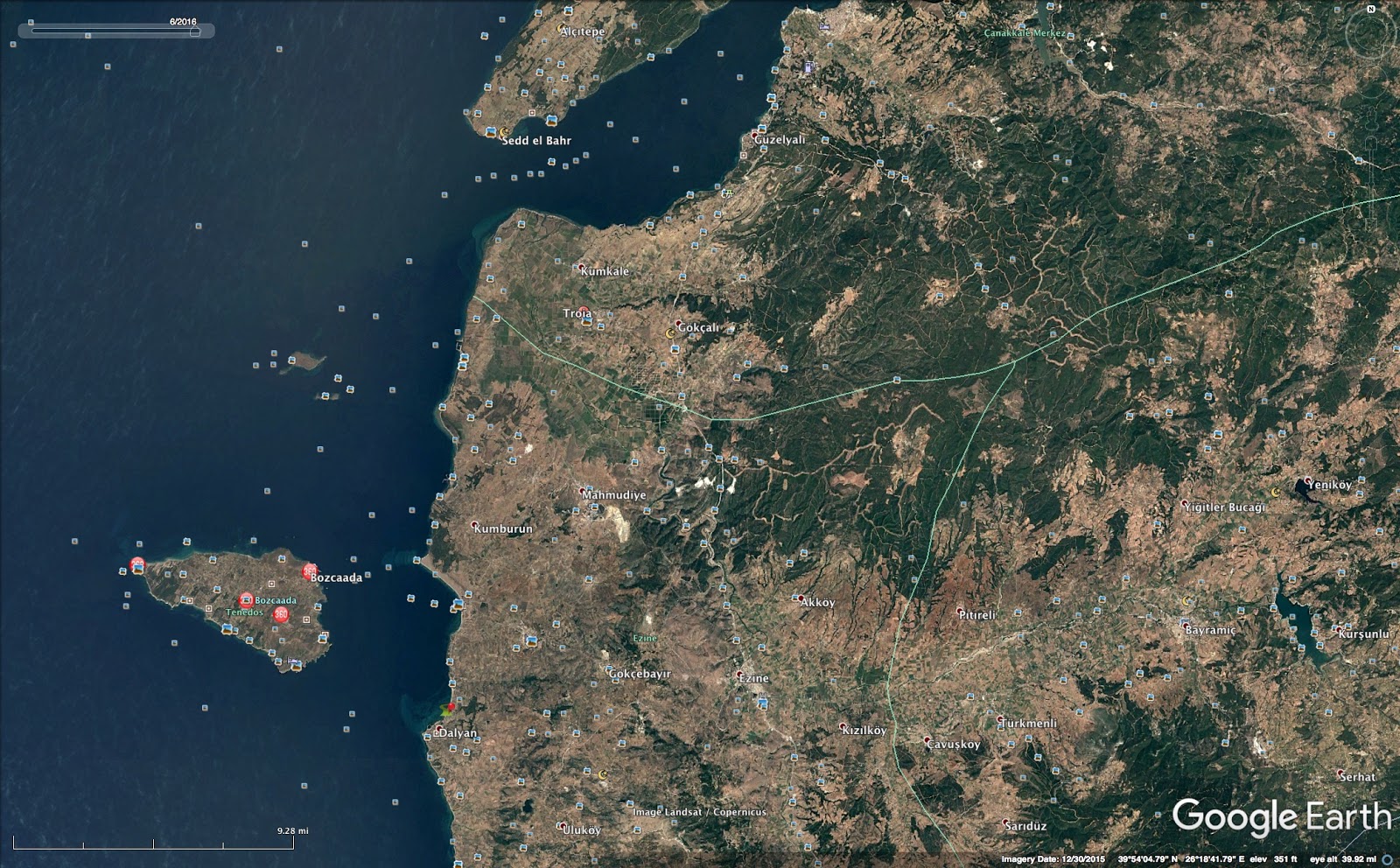
     After reading the passage above, observe the geographical features of the ancient city of Troy itself from Google Earth.  (Today referred to as Troia, Turkey.)  The second photo is from April 2016, and I have included it because of the illumination it provides of the potential fertility of the area.  With regards to the passage, pay particularly close attention to the second paragraph.  If you look carefully at the images, you can clearly see the rise or mound upon which the city rested, more secure in this vantage point from approaching enemies.  The third image provided is a more distant view of the area from above to convey greater context.


     The following image conveys a sense of the great journey Odysseus took by ship to reach Troy from Ithaca—and, of course, the much longer journey home. 


     The image directly above, courtesy OpenCulture.com, displays the hometowns of the cast of characters from the Iliad.  It has been pointed out by others, however, that most of the women—including Helen—have not been included.  


     While it may never be known whether, or not, Odysseus was based upon a real man, myths have a way of solidifying around that kernel of truth.  Since Troy has been demonstrated as having existed, perhaps there is more truth than fantasy to Homer’s epic works.  If so, these journeys represent an astonishing accomplishment for the period.